
Two manufacturers can purchase sodium carbonate of similar chemical purity and still experience different results during production.
The difference may have little to do with the chemical composition. Instead, it may come down to particle size, bulk density, handling characteristics and suitability for the manufacturing process.
This is an important distinction for Nigerian companies purchasing soda ash light or dense for detergent production, glass manufacturing, water treatment and other industrial applications.
Choosing the wrong grade can create unnecessary handling difficulties, affect dosing consistency, increase dust generation or complicate material storage.
For procurement managers, the challenge is not simply finding the cheapest soda ash supplier in Nigeria. It is identifying the grade that provides the best combination of technical performance, supply reliability and total procurement cost.
This guide explains the differences between light and dense soda ash, their industrial applications, important specifications and what Nigerian manufacturers should consider before placing an order.
What Is Soda Ash?
Soda ash is the commercial name for sodium carbonate (Na₂CO₃), an inorganic alkaline compound used across several manufacturing industries.
It is generally supplied as a white granular or powdered material.
Sodium carbonate serves several industrial functions, including regulating alkalinity, softening water, acting as a chemical intermediate and assisting manufacturing processes that require sodium compounds.
Major applications include detergent production, glass manufacturing, chemical processing, water treatment, ceramics and textile manufacturing.
Soda ash can be manufactured synthetically through processes such as the Solvay process or obtained from naturally occurring sodium carbonate minerals.
According to Solvay’s technical information, commercial soda ash production includes both synthetic manufacturing and processing natural trona deposits.
Is Soda Ash the Same as Caustic Soda?
No.
Soda ash is sodium carbonate (Na₂CO₃), while caustic soda is sodium hydroxide (NaOH).
Both are alkaline chemicals, but their chemical properties, handling requirements and industrial applications differ.
Soda ash should also not be confused with sodium bicarbonate (NaHCO₃), commonly called baking soda.
These materials are not automatically interchangeable in industrial formulations.
Soda Ash Light vs Dense: Understanding the Difference
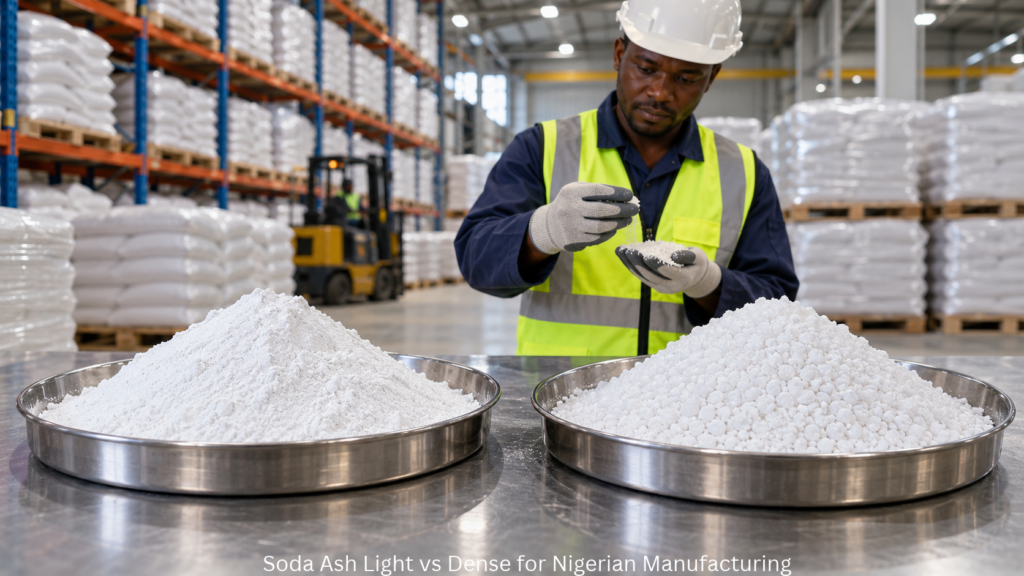
Light soda ash and dense soda ash share the same fundamental chemical composition.
The main differences involve their physical characteristics.
| Property | Soda Ash Light | Soda Ash Dense |
| Chemical name | Sodium carbonate | Sodium carbonate |
| Chemical formula | Na₂CO₃ | Na₂CO₃ |
| Appearance | Fine white powder | Coarser granular material |
| Typical bulk density | Approximately 0.5 t/m³ | Approximately 1.0 t/m³ |
| Particle characteristics | Generally finer | Generally coarser |
| Dust generation | Greater potential during handling | Generally lower |
| Common applications | Detergents and chemical processing | Glass and industrial processing |
| Storage volume per tonne | Generally higher | Generally lower |
| Handling considerations | Dust control and powder flow | Granular flow and equipment compatibility |
Note: These are representative characteristics, not universal purchasing specifications. Actual density, particle size and purity must be confirmed against the manufacturer’s Technical Data Sheet and batch Certificate of Analysis.
Solvay identifies a typical median particle diameter of approximately 100 microns for its light grade and 300–500 microns for its dense grade. It also identifies dense soda ash as the preferred grade for glass manufacturing because of its granular properties.
Why Bulk Density Matters
Bulk density describes how much material occupies a particular volume, including the spaces between particles.
Consider a simplified example.
A manufacturer purchasing 10 metric tonnes of soda ash may require approximately:
- 20 cubic metres of material volume for light soda ash at 0.5 t/m³.
- 10 cubic metres for dense soda ash at 1.0 t/m³.
These figures are illustrative and exclude packaging, pallet spaces and operational allowances.
The implication is straightforward.
Two products with the same weight can require significantly different storage and handling arrangements.
For manufacturers using silos, automated feeders or bulk material-handling systems, this difference can influence equipment selection and operating efficiency.
However, higher bulk density does not automatically mean lower freight cost. Actual freight economics depend on shipment weight limits, packaging, container dimensions and loading efficiency.
Which Industries Use Light Soda Ash?
Light soda ash is commonly associated with detergent manufacturing, chemical processing and applications requiring a relatively fine material.
1. Detergent and Cleaning Product Manufacturing
Soda ash is widely used in laundry detergents and cleaning formulations.
Depending on the formulation, it can function as an alkaline builder, help manage water hardness and contribute to cleaning performance.
Light soda ash is frequently selected for detergent applications because its physical properties can suit powder mixing and chemical-processing operations.
However, the correct grade depends on the manufacturer’s formulation and equipment.
A detergent producer should consider particle size, blending behaviour, moisture sensitivity and compatibility with other ingredients.
2. Chemical Manufacturing
Light soda ash is used as a raw material in the production of various sodium compounds.
These include sodium silicate, sodium bicarbonate and sodium percarbonate.
It also serves as an alkaline reagent in chemical processes requiring pH adjustment or neutralisation.
3. Water Treatment
Sodium carbonate can be used in water-treatment operations to increase alkalinity and assist hardness reduction.
Its application depends on water chemistry and the treatment process.
Manufacturers should confirm the appropriate grade and dosage through their technical teams.
4. Textile Processing
Light soda ash can be used in certain textile dyeing and processing applications where controlled alkalinity is required.
Which Industries Use Dense Soda Ash?
Dense soda ash is commonly preferred where granular characteristics, bulk density and reduced dust generation provide operational advantages.
1. Glass Manufacturing
Glass production is one of the major industrial applications of dense soda ash.
In conventional soda-lime glass manufacturing, sodium carbonate contributes sodium oxide to the glass composition and helps reduce the melting temperature of the raw-material mixture.
This supports the manufacture of products such as glass containers, bottles and flat glass.
Dense soda ash is generally preferred because its granular characteristics can reduce dust and material segregation during handling.
These advantages can be particularly important in large-scale glass manufacturing operations.
2. Chemical and Silicate Production
Dense soda ash is also used in selected chemical manufacturing processes, including sodium silicate production.
Its suitability depends on the process design and the manufacturer’s material specifications.
3. Metallurgical Applications
In certain metallurgical processes, soda ash acts as a flux or alkaline reagent.
The appropriate grade depends on process conditions and handling requirements.
4. Industrial Operations Using Bulk Storage
Manufacturers operating bulk silos or automated material-handling systems may prefer dense soda ash where its physical properties are compatible with their equipment.
Nevertheless, dense soda ash should not be selected solely because it occupies less space.
Material flow characteristics, process requirements and product specifications remain essential.
What Specifications Should Nigerian Manufacturers Check?
One of the most common chemical procurement mistakes is comparing quotations without comparing technical specifications.
Two suppliers may quote the same product name but offer materials with different impurity limits, particle sizes or packaging arrangements.
Before approving a soda ash purchase, manufacturers should review the following parameters.
Sodium Carbonate Purity
The assay indicates the proportion of sodium carbonate in the material.
For example, Tata Chemicals publishes a minimum total alkalinity specification, expressed as Na₂CO₃, of 99.0% for its light soda ash product. This is a manufacturer-specific specification rather than a universal minimum for every commercial grade.
Bulk Density
Bulk density influences storage requirements, material feeding and handling arrangements.
Confirm the acceptable range for your equipment.
Chloride Content
Chloride content may be relevant where impurities affect the manufacturing process or finished-product requirements.
Iron Content
Iron impurities can be particularly important in applications sensitive to colour or product appearance.
Water-Insoluble Matter
Excess insoluble material may create problems in processes requiring dissolution or consistent chemical quality.
Moisture Content
Moisture can affect storage stability, caking and material flow.
Particle Size Distribution
Particle characteristics may influence dust generation, mixing and feeding behaviour.
Required Documentation
Manufacturers should request the appropriate documentation, including:
- Technical Data Sheet (TDS)
- Certificate of Analysis (COA)
- Safety Data Sheet (SDS)
- Manufacturer identification
- Product grade and specification
- Country of origin
- Packaging details
- Batch identification and traceability information
The objective is to ensure that the purchased material matches the approved production specification.
What Determines Soda Ash Prices in Nigeria?
The price of soda ash in Nigeria is influenced by more than the international selling price.
For imported material, the commercial cost can include:
Product cost + international freight + insurance + applicable import charges + port handling + clearing + inland logistics + warehousing + financing costs.
Foreign-exchange exposure can also affect the naira cost of imported material.
Foreign Exchange
When soda ash is purchased internationally in US dollars, changes in the naira exchange rate can affect replacement costs.
The Central Bank of Nigeria’s official exchange-rate portal publishes Nigerian Foreign Exchange Market rates that businesses can use as reference information.
Manufacturers should therefore consider quotation validity and exchange-rate exposure when negotiating bulk purchases.
Freight and Shipment Size
The cost of transporting soda ash depends on shipment size, origin, packaging and shipping arrangements.
Bulk shipments may offer freight efficiencies for sufficiently large and predictable demand.
Containerised shipments may provide greater flexibility for smaller purchasing volumes.
Neither method is automatically cheaper in every transaction.
A proper comparison should consider the total landed cost per metric tonne.
Packaging and Inland Distribution
Soda ash may be supplied in bags or bulk packaging, depending on the manufacturer and logistics arrangement.
For Nigerian buyers, delivery from a Lagos warehouse to a manufacturing facility in another state may introduce additional transport and handling costs.
The cheapest ex-warehouse quotation may therefore not produce the cheapest delivered cost.
A Practical Procurement Example
Assume a manufacturer receives two quotations:
| Quotation | Supplier A | Supplier B |
| Product | Light soda ash | Light soda ash |
| Price per MT | ₦450,000 | ₦465,000 |
| Quantity | 20 MT | 20 MT |
| Delivery | Ex-warehouse | Delivered to factory |
| Documentation | Pending | Available |
| Delivery cost | Additional | Included |
These are hypothetical figures for illustration, not current Nigerian market prices.
Supplier A appears cheaper by ₦15,000 per metric tonne.
However, if additional logistics costs exceed that difference, Supplier B may offer the lower delivered cost.
This is why procurement managers should compare quotations on a consistent commercial basis.
Nigerian Import Requirements: What Buyers Should Know in 2026
Chemical importers should verify applicable tariff classifications, documentation and regulatory requirements before shipment.
Nigeria Customs provides an official Common External Tariff reference for checking tariff classifications and related requirements. Importers should confirm the applicable national tariff line and current charges rather than relying on historical duty assumptions.
There is also an important 2026 procedural development.
On 31 March 2026, the Standards Organisation of Nigeria published a notice confirming that, effective 27 March 2026, specified SONCAP and import-permit processes must be initiated or processed through Nigeria’s National Single Window platform.
The notice also addresses certificate activation for Form M, PAAR and cargo-clearance purposes. Standards Organisation of Nigeria
However, SONCAP requirements are not identical for every chemical import.
The Standards Organisation of Nigeria distinguishes between certain raw materials imported by bona fide manufacturers and commercial goods intended for resale or distribution. Applicable exemptions and permits must be assessed according to the product and transaction.
Procurement implication: Before importing soda ash, confirm the applicable regulatory pathway with your licensed customs agent and the relevant authorities.
Incorrect assumptions about certification or documentation can create avoidable clearance delays.
How Should Soda Ash Be Stored?
Soda ash should be stored according to the manufacturer’s Safety Data Sheet and applicable workplace procedures.
General precautions include maintaining dry storage conditions, protecting packaging from moisture and keeping the material away from incompatible substances such as acids.
Suitable protective equipment should be used during handling, particularly where dust exposure is possible.
For Nigerian warehouses, procurement and warehouse teams should pay particular attention to damaged bags, moisture exposure, ventilation and proper pallet storage.
Poor storage conditions can undermine the quality of otherwise acceptable material.
What This Means for Nigerian Manufacturers
Selecting the right soda ash grade should be a joint decision involving procurement, production and quality assurance.
Five practical considerations deserve attention.
1. Confirm the application before requesting quotations. A detergent manufacturer and a glass manufacturer may have different requirements, even when purchasing sodium carbonate.
2. Compare technical specifications, not just product names. Bulk density, particle size and impurity limits can be as important as purity.
3. Evaluate the delivered cost. Include freight, packaging, local logistics and handling costs when comparing suppliers.
4. Plan purchases around consumption patterns. Regular demand forecasts can help improve replenishment planning and reduce emergency purchases.
5. Maintain qualified alternative sources. Supply continuity improves when manufacturers have more than one technically acceptable sourcing option.
The commercial objective is not simply to buy soda ash at the lowest available price.
It is to secure the correct material at a sustainable cost while protecting production continuity.
How to Request a Soda Ash Quotation in Nigeria
A clear quotation request helps suppliers provide more accurate offers.
Procurement teams should specify:
| Requirement | Information to Provide |
| Product | Sodium carbonate |
| Grade | Light or dense |
| Purity | Required minimum assay |
| Quantity | Kilograms or metric tonnes |
| Packaging | Preferred bag or bulk format |
| Manufacturer | Preferred brand, if applicable |
| Documentation | COA, TDS and SDS |
| Delivery location | Factory or warehouse address |
| Delivery schedule | Required date or recurring demand |
| Commercial terms | Delivery basis and payment requirements |
If the required grade is uncertain, obtain technical confirmation before placing an order.
Frequently Asked Questions
Is Light Soda Ash Better Than Dense Soda Ash?
Neither grade is universally better.
Light soda ash is commonly used in detergents and chemical applications, while dense soda ash is generally preferred for glass manufacturing.
The correct choice depends on the manufacturing process.
Can Light Soda Ash Replace Dense Soda Ash?
Both grades contain sodium carbonate, but substitution should not be automatic.
Differences in bulk density, particle size, material flow and dust generation may affect equipment and production performance.
Any substitution should be approved through the manufacturer’s technical evaluation process.
Which Soda Ash Grade Is Used in Detergent Production?
Light soda ash is widely used in detergent manufacturing.
However, some formulations and production systems may accommodate other grades.
The final choice should follow formulation and process requirements.
Where Can Manufacturers Source Soda Ash in Nigeria?
Manufacturers can approach established industrial chemical suppliers and sourcing companies capable of confirming the required grade, specifications, quantity, documentation and delivery terms.
Looking for Soda Ash Light or Dense in Nigeria?
The right chemical raw material should support production, not introduce avoidable uncertainty.
Atlas Biochemicals Limited supports Nigerian manufacturers with chemical raw-material sourcing, industrial supply and procurement solutions.
Whether your company requires light soda ash for detergent manufacturing or dense soda ash for an industrial application, our team can discuss your product specifications, quantity, packaging preferences and delivery requirements.
Contact Atlas Biochemicals Limited to request a quotation or discuss your upcoming sodium carbonate requirements.
Reliable chemicals. Uninterrupted production.